
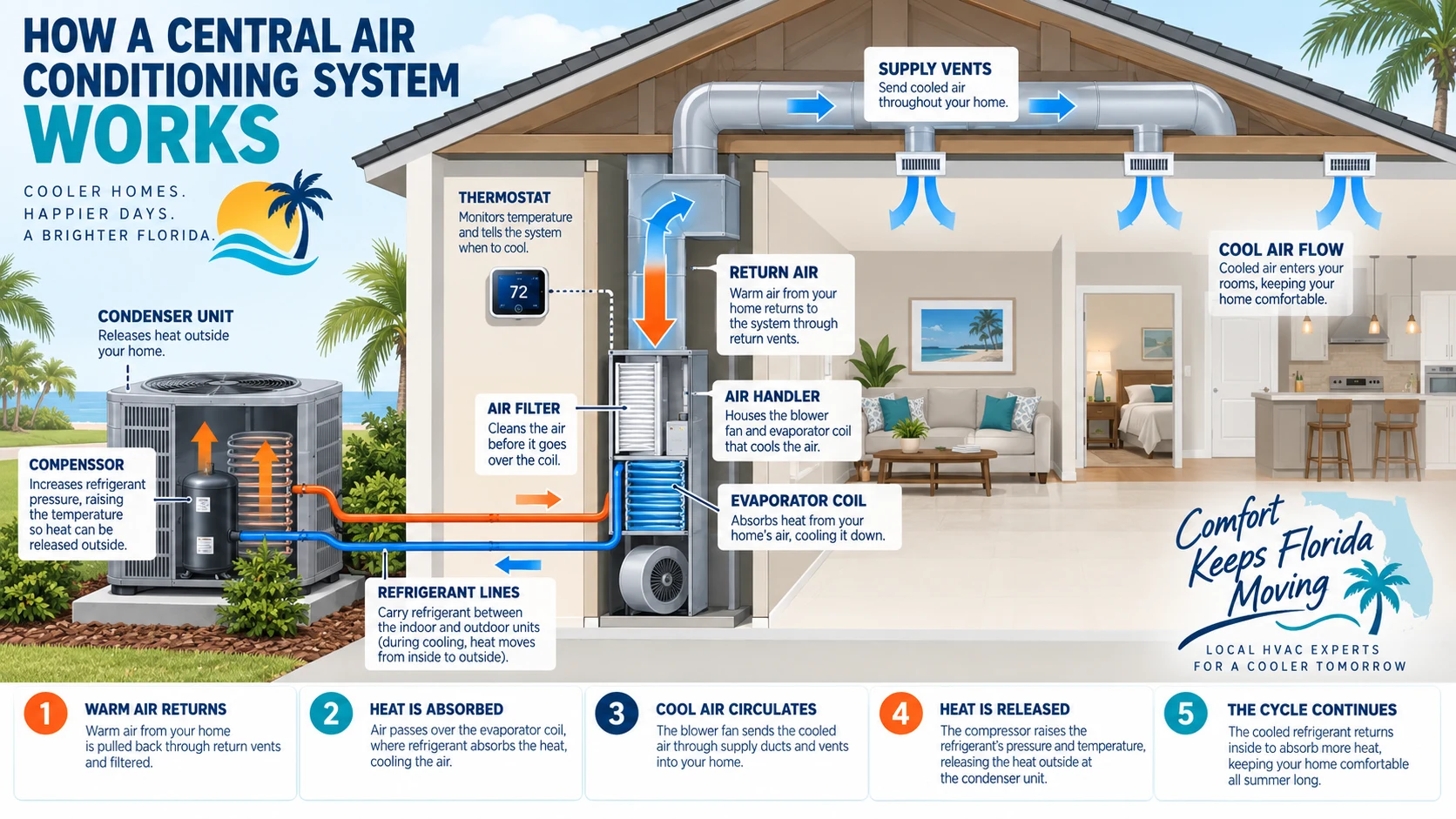
The Thermostat Calls for Cooling
The cycle starts when the thermostat senses the room temperature has drifted above its setpoint. It closes an electrical circuit that tells the outdoor condenser to start and the indoor blower to run. If the thermostat is miswired, has a dead battery, or is reading the temperature incorrectly, the rest of the system may be in perfect working order and still never get the signal to turn on — which is why thermostat problems are often mistaken for bigger mechanical failures.
Return Air and the Filter
Once the system is called on, the blower pulls warm air out of the living space through return air grilles and ducts back toward the air handler. Before that air reaches the evaporator coil, it passes through the air filter, which catches dust, hair, and debris. A clogged filter restricts how much air can move through the system — less air across the coil means less heat gets absorbed per cycle, and in more severe cases, restricted airflow lets the coil get cold enough to ice over entirely.
The Evaporator Coil and Refrigerant's Phase Change
Inside the air handler, the return air passes across the evaporator coil, a set of finned tubing filled with cold, low-pressure liquid refrigerant. As the warmer room air moves across the coil's surface, heat transfers from the air into the refrigerant. That heat causes the refrigerant to change from a liquid to a gas — a phase change that absorbs a large amount of heat compared to simply warming a liquid, which is what makes refrigerant so effective at moving heat compared to, say, water. The air leaving the coil is now several degrees cooler than when it entered.
At the same time, moisture in the air condenses on the cold coil surface, which is where a system's dehumidifying effect comes from. That water collects in a drain pan below the coil and exits through a condensate line — a line that clogs with algae and debris over time and, when it does, can back up and overflow into the drain pan or onto the floor around the air handler.
The Compressor Moves the Heat Outside
The now-gaseous, heat-carrying refrigerant travels through a line out to the outdoor unit, where the compressor's job is to squeeze that gas into a smaller volume, raising both its pressure and its temperature substantially. This step matters because refrigerant needs to be hotter than the outdoor air for the next step to work — heat only transfers from something hotter to something cooler, so the refrigerant has to be made hotter than the Florida afternoon it's about to release that heat into.
The Condenser Coil and Outdoor Fan Release the Heat
The hot, high-pressure refrigerant gas flows into the condenser coil in the outdoor unit. The condenser fan pulls outside air across that coil, and heat transfers from the refrigerant into the outside air, causing the refrigerant to condense back into a liquid — the reverse of what happened at the evaporator coil indoors. A dirty condenser coil or a fan that isn't moving enough air through it makes this step less effective, which raises pressures throughout the system and can trip a protective shutoff or push the compressor toward premature failure.
Back to the Beginning
The now-liquid, high-pressure refrigerant travels back indoors through a second line, passes through a metering device that drops its pressure sharply, and arrives back at the evaporator coil as a cold liquid, ready to absorb heat again. This loop repeats continuously as long as the thermostat is calling for cooling, cycling on and off to hold the room at the setpoint.
Meanwhile, the blower keeps pushing the cooled, dehumidified air through the supply ducts and out registers into the living space. If those ducts leak, are crushed, or are poorly insulated, some of that cooling effect is lost before it reaches the room — a separate problem from anything happening at the coil or compressor, covered on the ductwork repair page.
Why Regular Maintenance Matters for This Cycle
Every step in this loop depends on the previous one working correctly: airflow across the evaporator coil, refrigerant charge, compressor function, and airflow across the condenser coil. A problem at any single point in the loop tends to show up as reduced cooling everywhere else, which is why routine maintenance — cleaning coils, checking refrigerant, clearing the condensate line — is aimed at catching a weak link before it causes the whole cycle to underperform or fail outright.
System not behaving the way it should?
If any part of this cycle sounds like it's not happening correctly at your house, call 321-334-2567 to talk through the symptoms.