
The Full Range of Reasons an AC Stops Cooling
The single symptom "AC not cooling" can point to a dozen different problems, and they don't all carry the same urgency or cost. Some, like a dirty filter, are a five-minute fix a homeowner can do without any tools. Others, like a failed compressor, require a technician and a real conversation about repair versus replacement. Sorting through the possibilities in order — from simplest to most involved — is the fastest way to figure out where the problem actually sits.
Airflow Restrictions
A dirty filter is the most common airflow problem, and it's also the easiest to check yourself. A filter clogged with dust and pet hair chokes off the volume of air moving across the indoor coil, which reduces cooling capacity and can eventually cause the coil to ice over. Closed or blocked supply vents, furniture pushed against a return grille, and collapsed sections of flexible ductwork all produce a similar effect by limiting how much air the system can move, even when every other component is working correctly.
Dirty Condenser Coil
The outdoor condenser coil is where the system releases the heat it collected from inside the house. When that coil is coated in dirt, grass clippings, pollen, or the fine debris that collects near landscaping, it can't shed heat efficiently, and the whole system loses cooling capacity as a result. This tends to develop gradually over a season rather than appear overnight, which is part of why it's easy to overlook until cooling has noticeably declined.
Frozen Evaporator Coil
The evaporator coil sits inside the air handler and is where heat and humidity are pulled out of the household air. When airflow across that coil is restricted, or when refrigerant charge is low, the coil can drop below freezing and form a layer of ice. Once ice builds up, airflow drops even further, which accelerates the freezing and can eventually stop cooling altogether. A frozen coil needs to thaw completely — with the system off — before a technician can diagnose whether the root cause was airflow or refrigerant.
Low Refrigerant
Refrigerant circulates in a sealed system and isn't consumed during normal operation, so a low charge always means refrigerant has leaked out somewhere — a coil, a fitting, or the line set. Low refrigerant reduces the system's ability to absorb heat from the house, producing weaker cooling, longer run times, and often ice on the indoor coil. Finding and repairing the leak, not just topping off refrigerant, is what actually fixes this cause.
Condenser Fan or Capacitor Failure
The condenser fan pulls outside air across the coil to help release heat. If its capacitor has weakened or failed, the fan may not start at all, even though the compressor is running and drawing power — a combination that leads to overheating and premature compressor shutdown. A humming outdoor unit with a fan that isn't spinning is a common sign of this specific failure.
Blower Problems and Duct Leaks
Inside the air handler, a weak or failing blower motor moves less air through the ductwork, which shows up as weak airflow at the vents even when the outdoor unit sounds normal. Separately, significant duct leaks in an attic or crawlspace can let cooled air escape before it ever reaches the living space, which sometimes shows up as one part of the house cooling fine while another stays warm. See ductwork repair for more on diagnosing leaks.
Compressor Failure
The compressor is the component that actually moves refrigerant through the system and does most of the work of cooling. A failed or failing compressor is one of the more serious causes on this list, often showing up as a system that hums but never starts, or trips a breaker repeatedly. Because compressors are a major cost item, a technician will usually check the system's age and refrigerant type before recommending a repair versus discussing replacement.
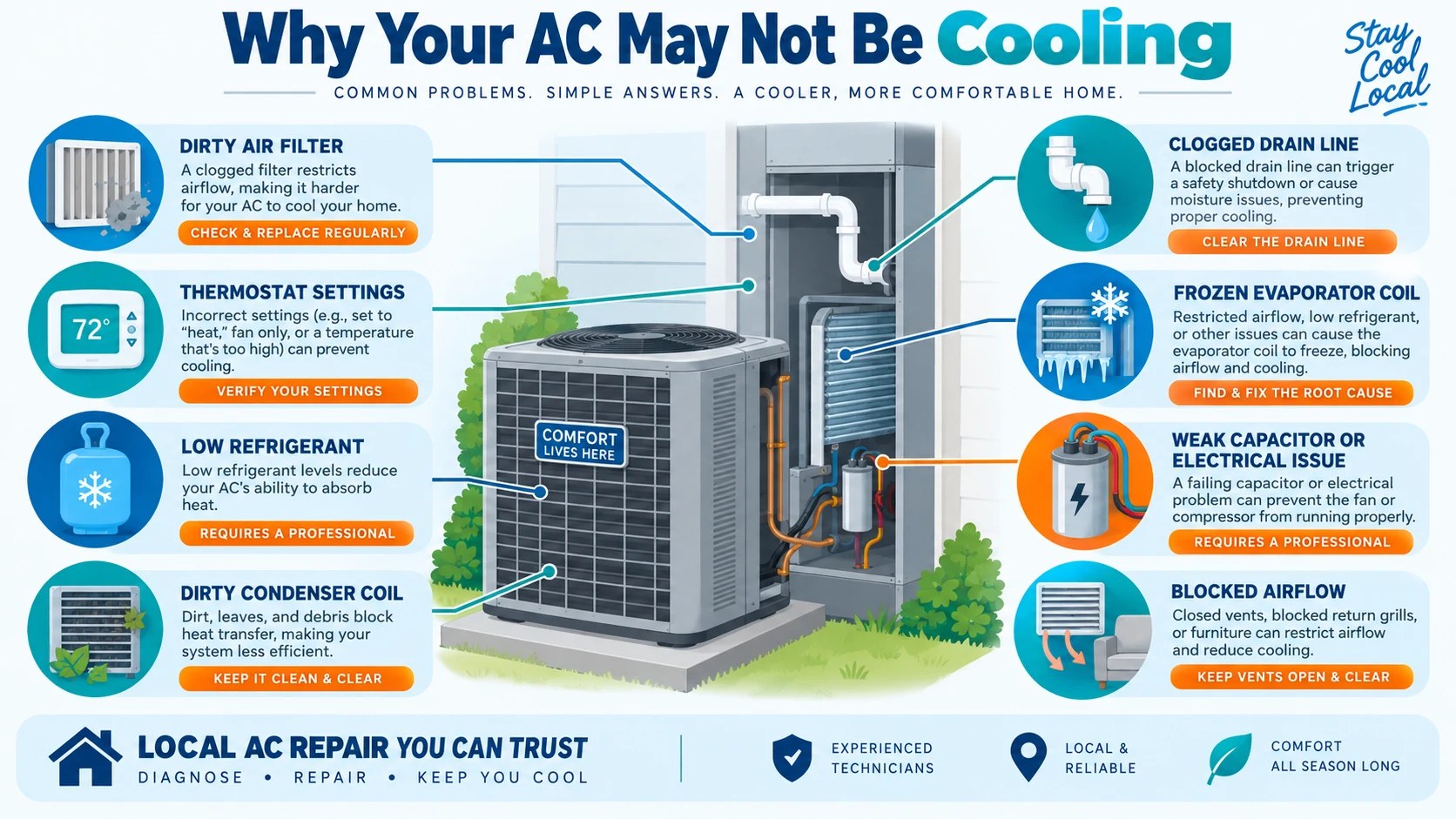
The chain of events shown above is worth walking through in plain terms. Almost every cooling complaint starts either with something blocking airflow or something preventing heat exchange at one of the two coils. Restricted airflow at the filter, vents, or blower backs up into the evaporator coil, dropping its temperature until ice forms — and once ice covers the coil, even a perfectly healthy compressor and a full refrigerant charge can't produce cool air at the vents. On the outdoor side, a dirty condenser coil or a fan that isn't spinning traps heat at the condenser instead of releasing it outside, which raises pressures inside the sealed system and can trip a safety switch or strain the compressor. Low refrigerant sits in a category of its own, since it isn't an airflow problem at all — it reduces the system's basic capacity to absorb heat regardless of how well air is moving. Reading the diagram this way — airflow path on one side, heat-exchange path on the other — is generally how a technician narrows down where to start testing.
Homeowner-Safe Troubleshooting Checklist
- Set the thermostat to "cool" and a few degrees below the current room temperature, and confirm the display is on.
- Check the breakers for the outdoor condenser and the indoor air handler, and reset any that have tripped.
- Pull the air filter and hold it up to a light — replace it if you can't see light through it clearly.
- Walk the house and make sure supply and return vents are open and not blocked by furniture or rugs.
- Look at the outdoor unit for visible debris, grass clippings, or overgrown landscaping against the coil.
- If you see ice anywhere on the indoor coil or outdoor line, switch the thermostat to "off" and the fan to "on" to let it thaw before calling.
What Requires a Technician
Some of the causes above simply cannot be safely or effectively addressed without proper tools and training. This includes anything involving refrigerant — checking the charge, finding a leak, or recovering and recharging the system — as well as electrical diagnosis and repair inside the outdoor unit or air handler, replacing a capacitor, contactor, or motor, and any sealed-system work such as coil replacement or compressor repair. These jobs involve pressurized refrigerant or live electrical components and are not homeowner tasks.
Get the symptom in front of a technician
Call 321-334-2567 or reach out through contact and describe what you're seeing — airflow, ice, noise, or a tripped breaker all point the diagnosis in a different direction.